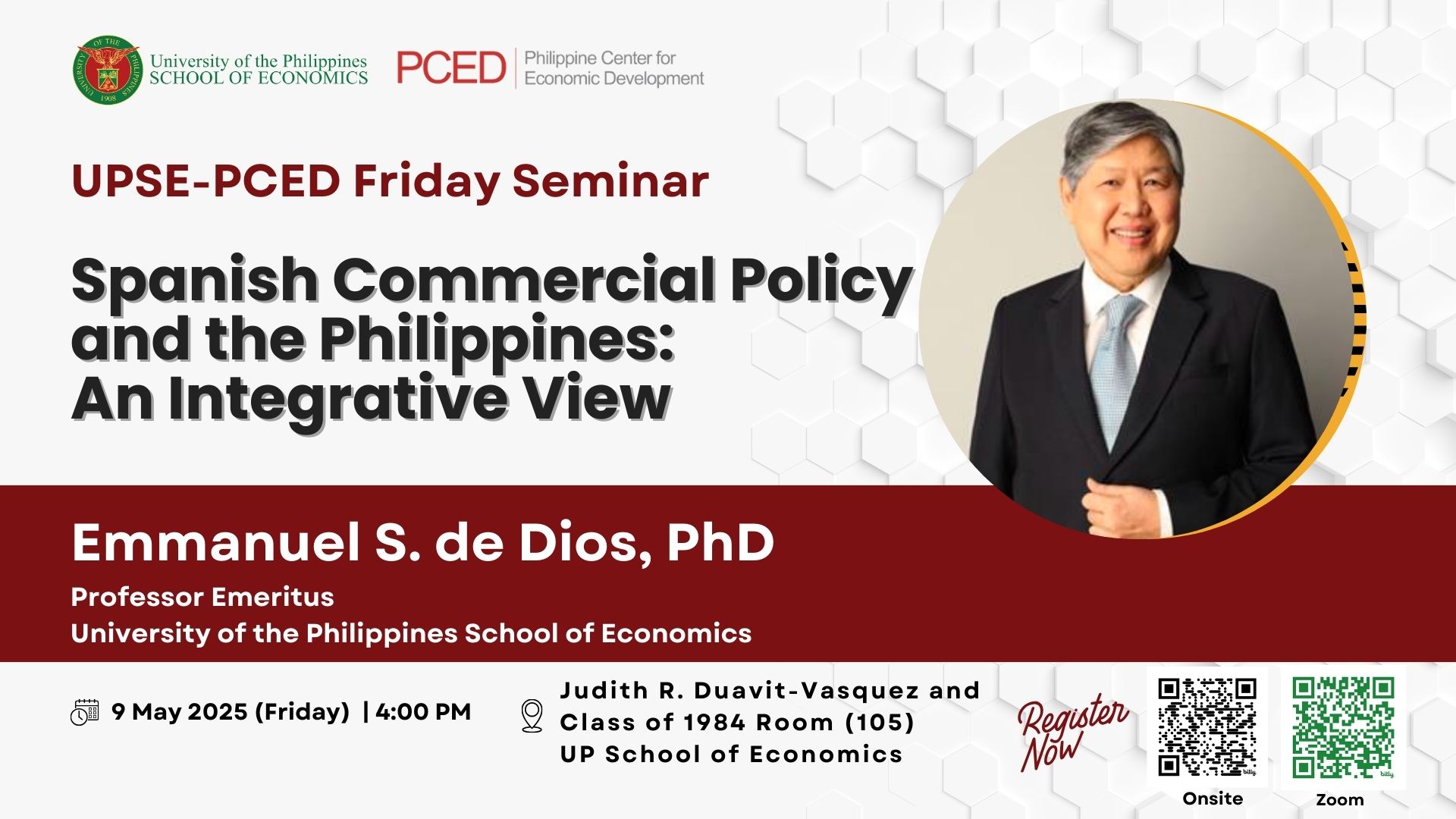
Don’t miss the seminar on “Spanish commercial policy and the Philippines: An integrative view.”
Read more
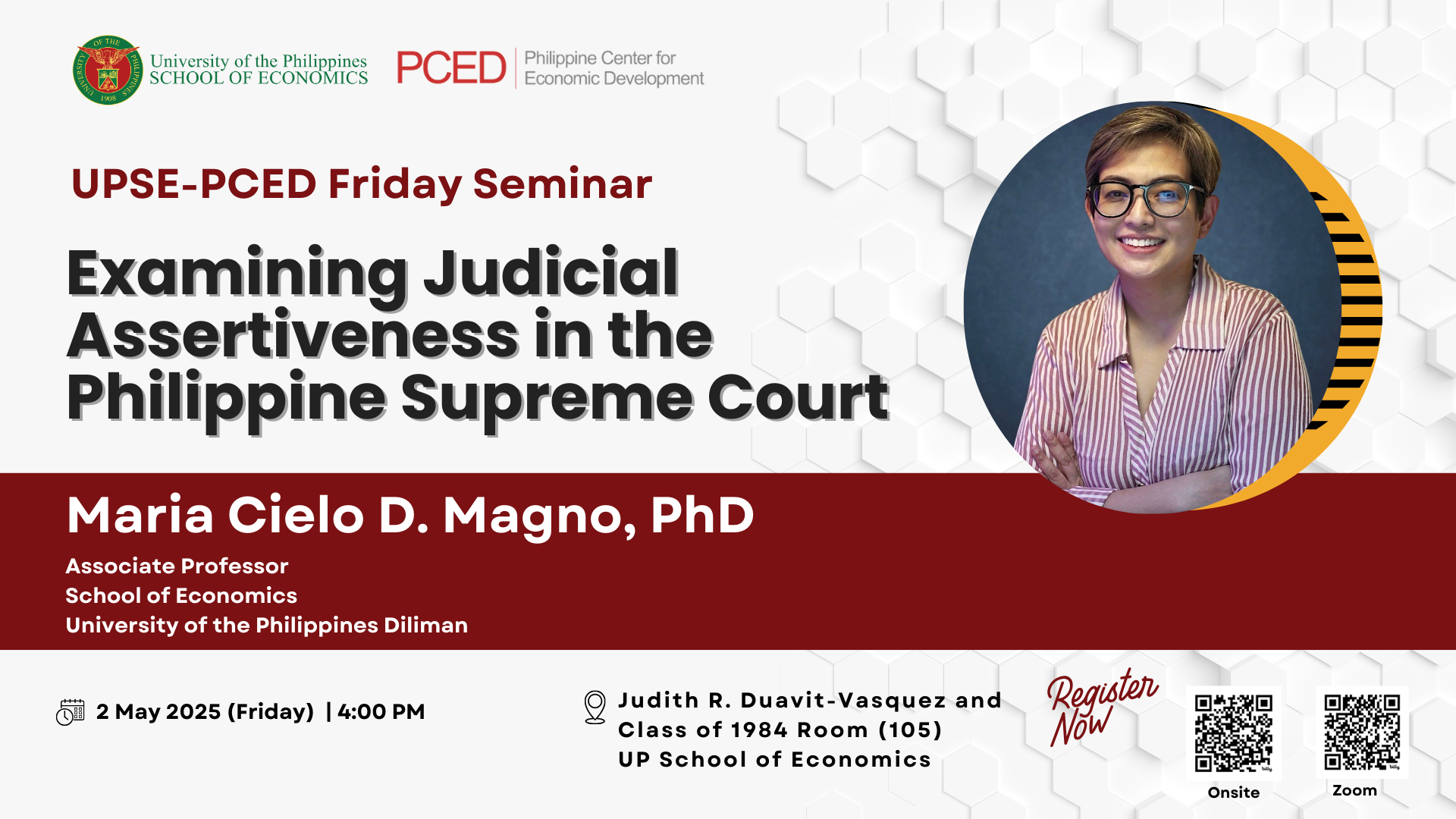
FriSem: Examining Judicial Assertiveness in the Philippine Supreme Court
Strong institutions shape stable economies. Take a closer look at how judicial checks influence policy outcomes, governance efficiency, and long-term economic growth. Watch live: https://youtube.com/live/1UMGrLLMv-c?feature=share #UPSchoolOfEconomics #UPSE #Philippine Center for Economic Development #PCED #FridaySeminar2025 #FriSem2025 #UPSEPCEDFriSem2025
Read more
Read more
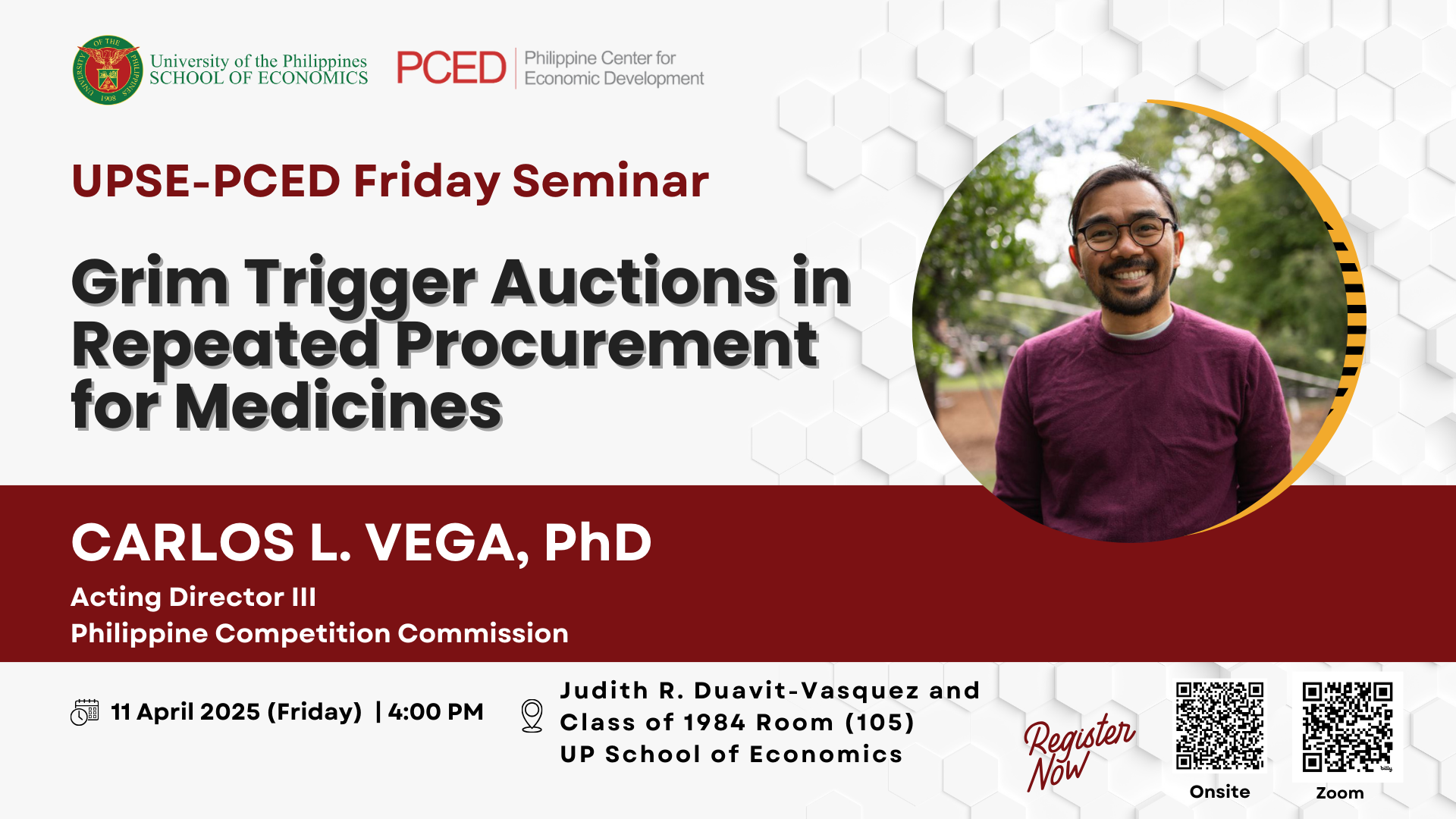
FriSem: Grim Trigger Auctions in Repeated Procurement for Medicines
Don’t miss the seminar, “Grim Trigger Auctions in Repeated Procurement for Medicines,” and discover how bid caps based on past prices can lower costs—but may also risk failed auctions. Register now: Onsite:https://bit.ly/4iURa2T Zoom:https://bit.ly/4ciYPFK
Read more
Read more
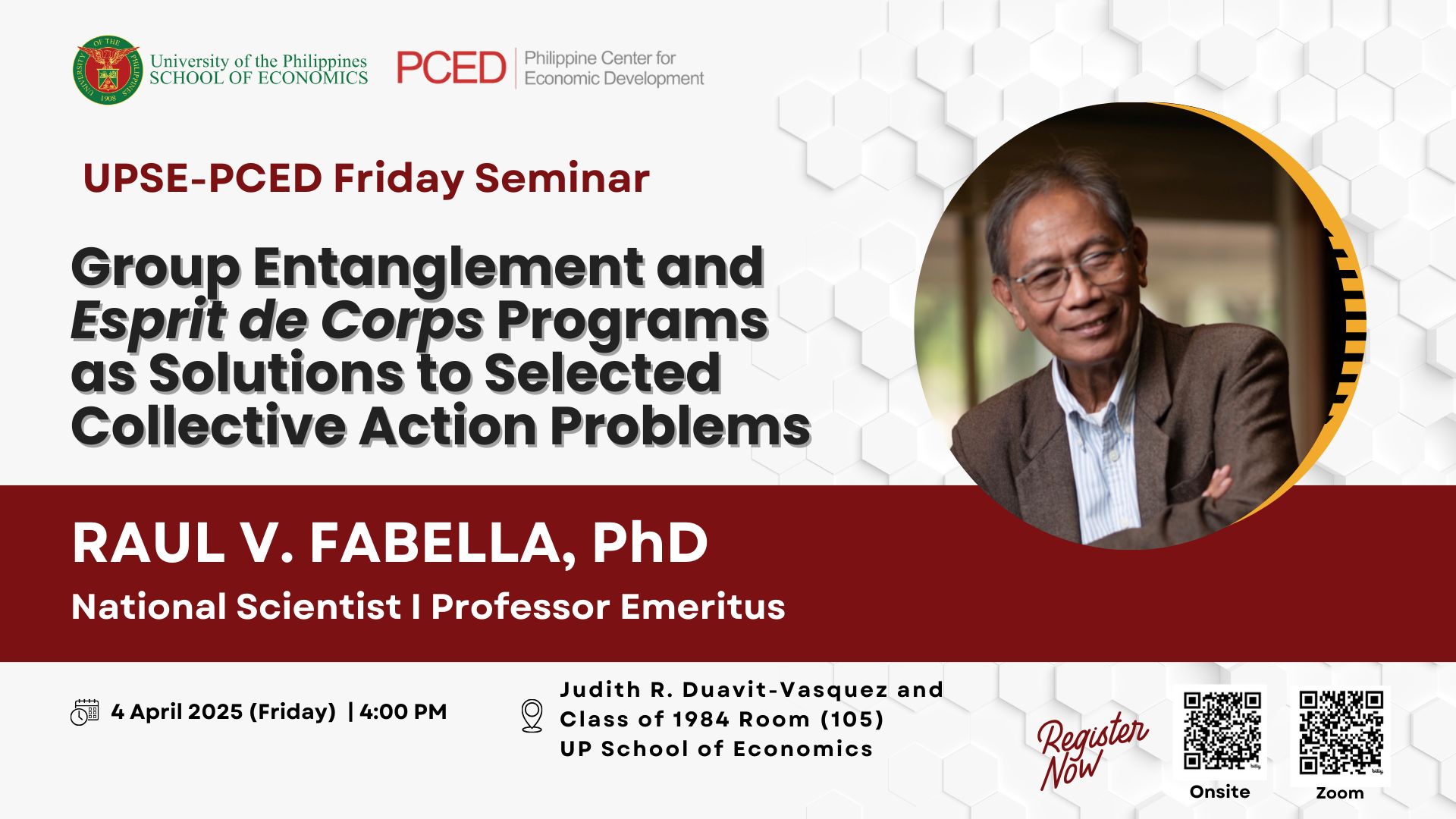
FriSem: Group Entanglement and Esprit de Corps Programs as Solutions to Selected Collective Action Problems
Do you want to learn more about programs that pose solutions to collective action problems (CAP)? Don’t miss this seminar by UPSE Prof. Emeritus Raul Fabella by registering via the links below: 𝗢𝗻𝘀𝗶𝘁𝗲 𝗥𝗲𝗴𝗶𝘀𝘁𝗿𝗮𝘁𝗶𝗼𝗻: https://bit.ly/3G1xvj2 𝗭𝗼𝗼𝗺: https://bit.ly/43A9w4v
Read more
Read more
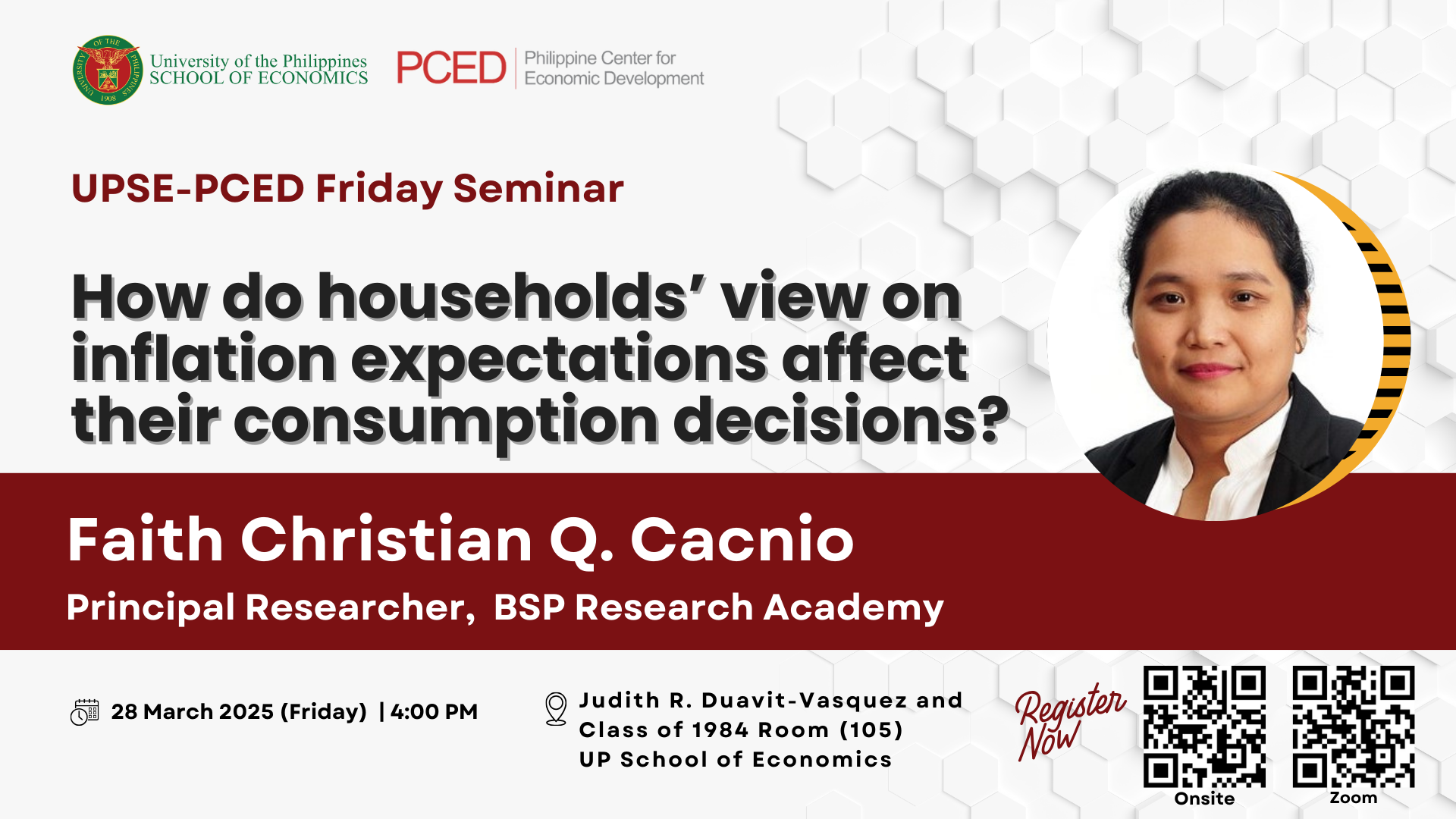
FriSem: How Do Households’ View On Inflation Expectations Affect Their Consumption Decisions?
Do you want to know how economic shocks affect inflation expectations and household consumption? This lecture explores how households perceive future price changes and the subsequent impact of these perceptions on their consumption decisions. Don’t miss this seminar by registering via the links below: 𝗢𝗻𝘀𝗶𝘁𝗲 𝗥𝗲𝗴𝗶𝘀𝘁𝗿𝗮𝘁𝗶𝗼𝗻:https://tinyurl.com/ybd45zfm 𝗭𝗼𝗼𝗺:https://tinyurl.com/46wpt2ek
Read more
Read more
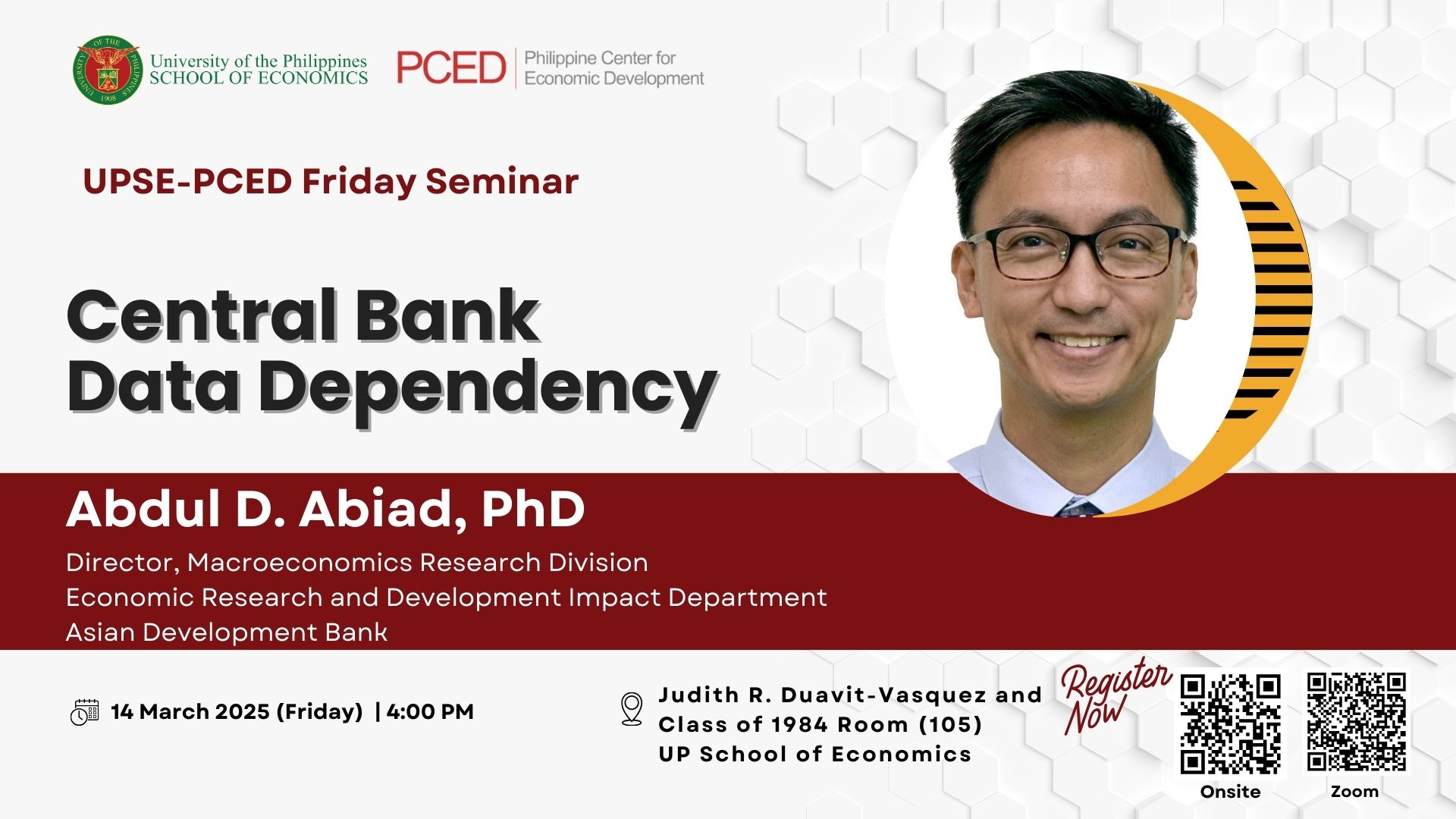
FriSem: Central Bank Data Dependency
Learn about new measures of central bank data dependency–the extent to which a central bank will adjust its policy stance in response to incoming data–for the Federal Reserve and the European Central Bank. These measures show that data dependency varies over time and reached record highs in the post-pandemic period. Join us in person or
Read more
Read more
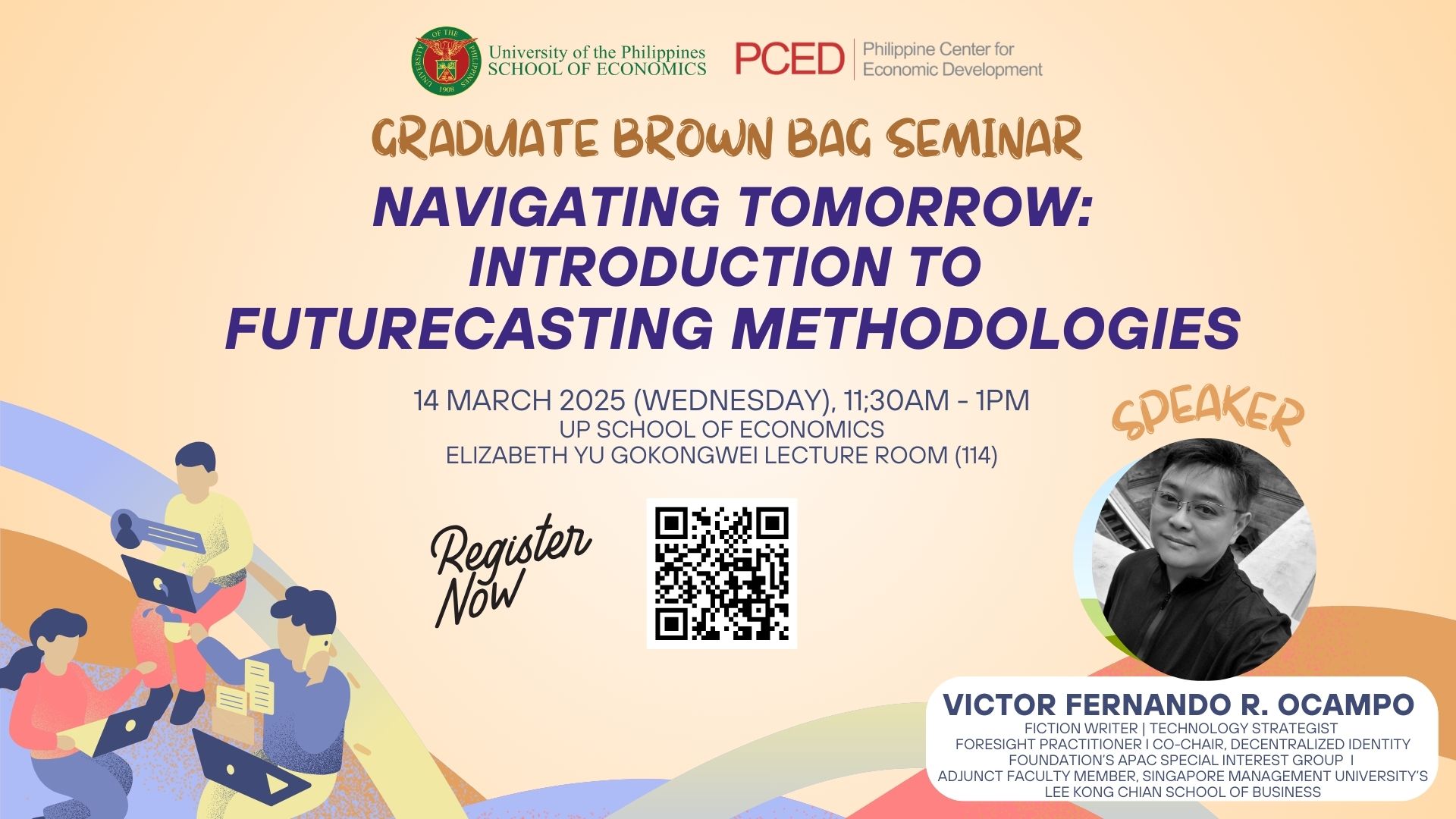
Graduate Brown Bag: Navigating Tomorrow: Introduction to Futurecasting Methodologies
Do you want to know more about Futurecasting? The lecture will emphasize the practical applications of futurecasting methodologies such as science fiction prototyping, archetype user journey analysis, and threatcasting in business, policy, and innovation. Don’t miss this opportunity to deepen your knowledge of futurecasting, and apply this in analyzing emerging technologies, societal shifts, and global
Read more
Read more
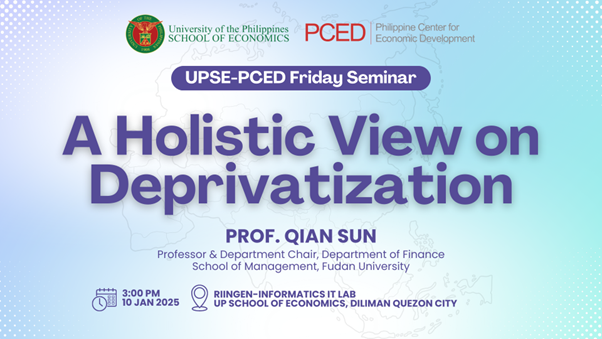
Holistic View on Deprivatization
On January 10, 2025, the UP School of Economics (UPSE) and the Philippine Center for Economic Development (PCED) hosted a seminar titled “A Holistic View on Deprivatization” from 3:00 PM to 5:00 PM at the Riingen Informatics IT Lab. The event featured Prof. Qian Sun, Professor of Finance and Chair of the Department of Finance
Read more
Read more
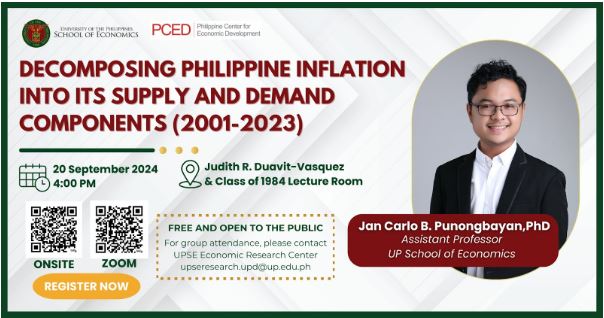
Decomposing Philippine Inflation into Its Supply and Demand Components (2001-2023)
The UP School of Economics hosted a seminar entitled “Decomposing Philippine Inflation into Its Supply and Demand Components (2001-2023)” presented by Assistant Professor Jan Carlo B. Punongbayan on September 20, 2024 (Friday), at 4:00 PM, which took place in Room 105 (Judith R. Duavit-Vasquez and Class of 1984 Lecture Room). The seminar was also accessible
Read more
Read more
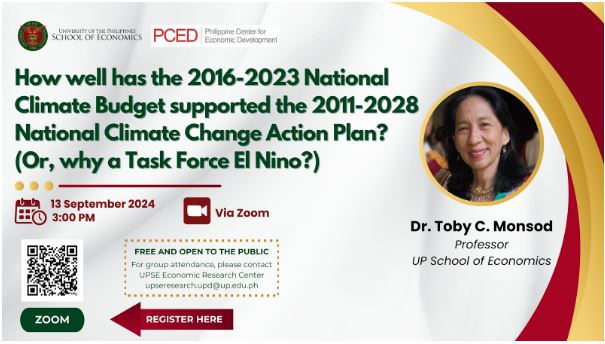
How well has the 2016-2023 National Climate Budget supported the 2011-2028 National Climate Change Action Plan? (Or, why a Task Force El Niño?)
The UP School of Economics held a seminar titled “How well has the 2016-2023 National Climate Budget supported the 2011-2028 National Climate Change Action Plan? (Or, why a Task Force El Niño?)” on September 13, 2024 (Friday) at 3:00 PM. The seminar, presented by Dr. Toby C. Monsod, a professor at UP School of Economics,
Read more
Read more
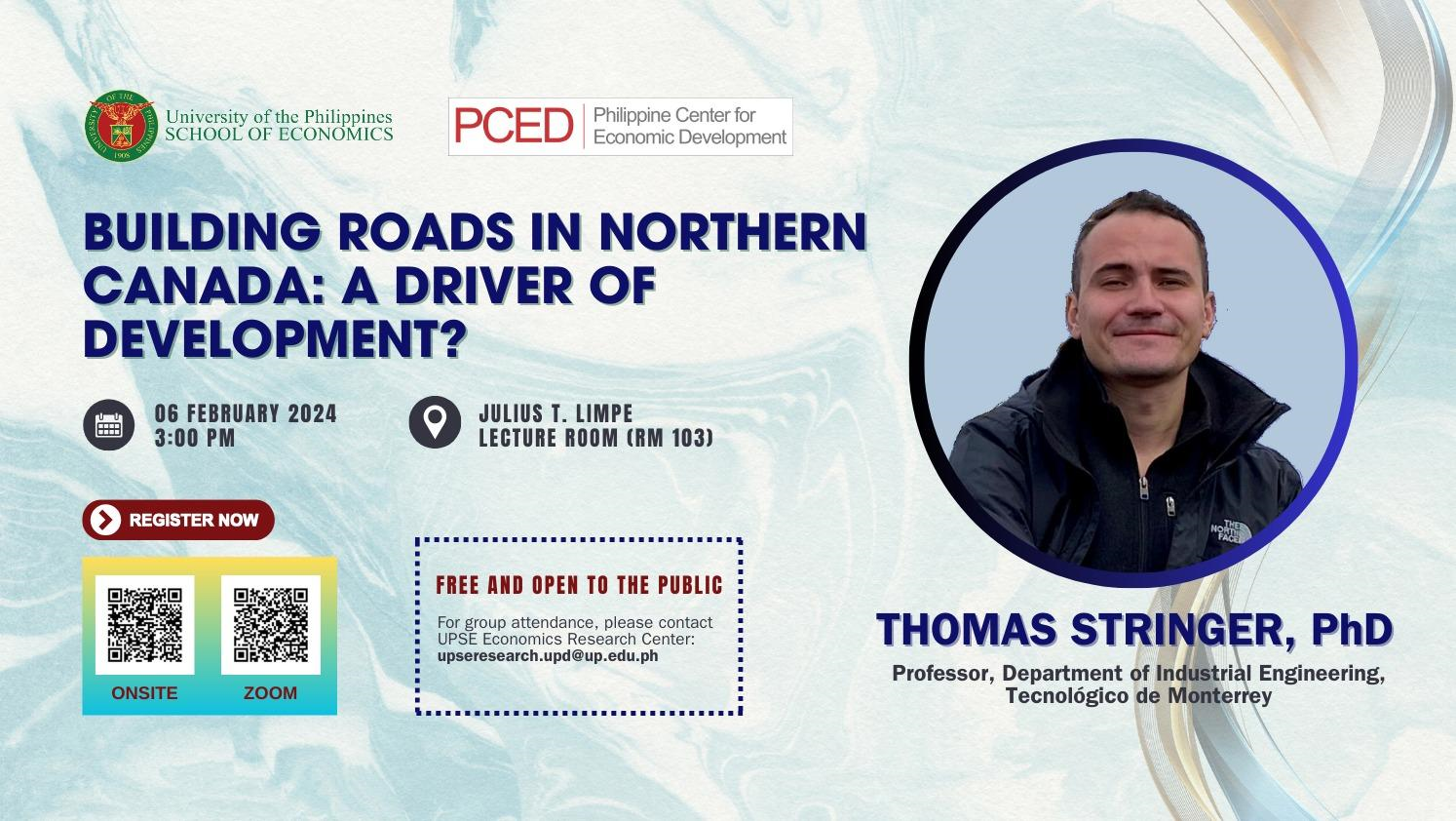
Building Roads in Northern Canada: A Driver of Development?
Speaker: Thomas Stringer, PhD (Professor, Department of Industrial Engineering, Tecnológico de Monterrey Date: 6 February 2024, 3:00 pm Venue: Julius T. Limpe Lecture Room (Room 103) Abstract: The paper examines the economic effects of road connection, using Northern Canada as a case study. It will also outline some of the policy options explored for developing
Read more
Read more
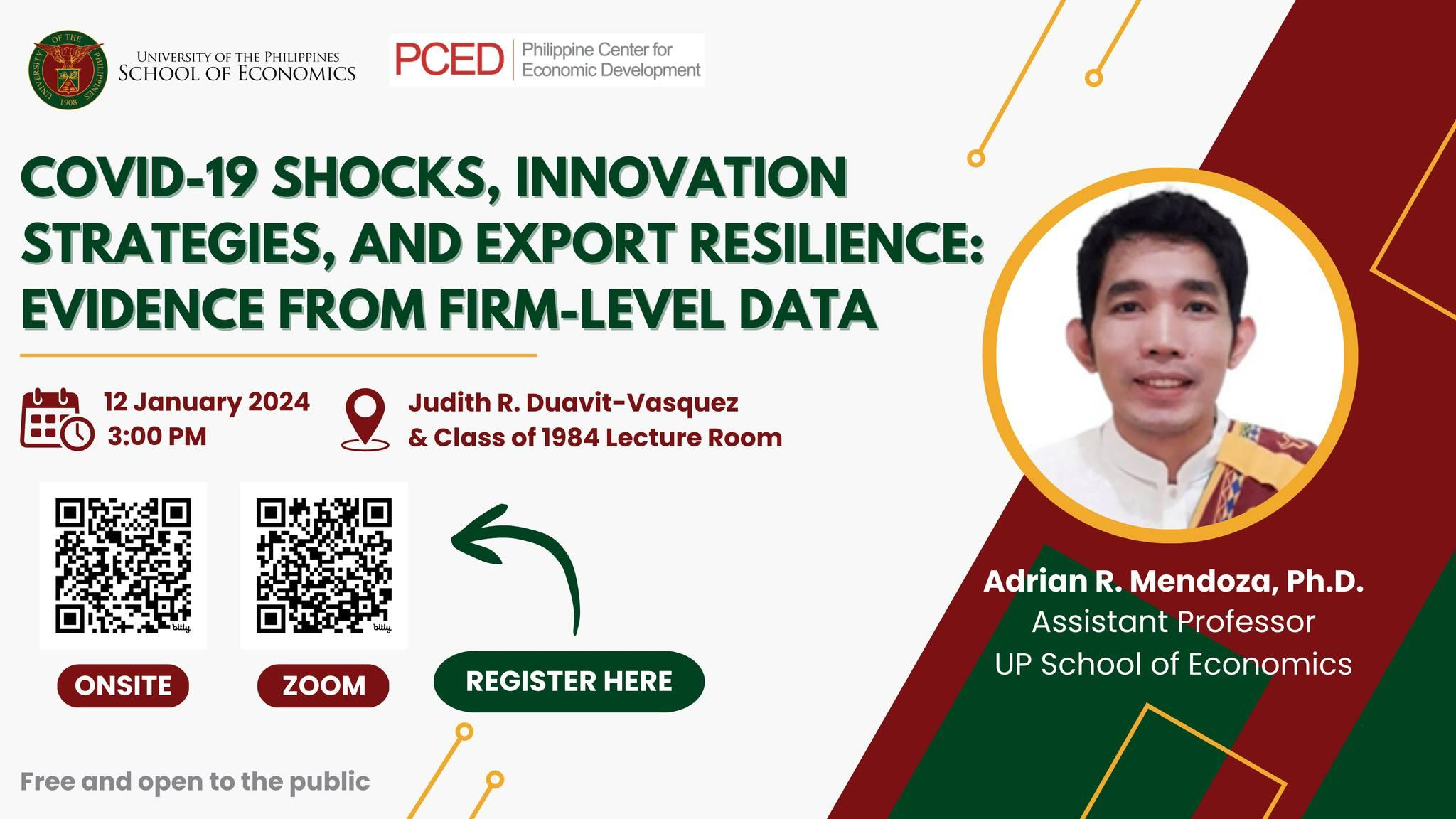
COVID-19 Shocks, Innovation Strategies, and Export Resilience: Evidence from Firm-Level Data
Speaker: Adrian Mendoza, PhD (Assistant Professor, UP School of Economics) Date: 12 January 2024, 3:00 pm Venue: Judith R. Duavit-Vasquez & Class of 1984 Lecture Room (Room 105) Abstract: A large firm-level dataset that covers 23 countries was assembled from the World Bank Establishment Surveys and COVID-19 Surveys to analyze the impact of COVID-19 shocks
Read more
Read more
Examining generic competition in the statins drug market in the Philippines
Speaker: Maria Cielo D. Magno Date: 06 October 2023 Time: 4:00 PM Venue: Judith R. Duavit-Vasquez & Class of 1984 Lecture Room Other Details: None Abstract: One approach to reduce the cost of medicine is through generic drug competition. The Generics Act of 1988 (R.A. No. 6675) requires government health agencies and personnel to use
Read more
Read more
Fiscal Policy Options for Resilient and Sustainable Development
Speaker: Ethisham Ahmad Date: 27 June 2023 Time: 4:00 PM Venue: Judith R. Duavit-Vasquez & Class of 1984 Lecture Room Other Details: None Abstract: The Pandemic has underlined the importance of uncertainty in modeling and policy design, which also applies to the increasing frequency and intensity of climate shocks. Policies based on static market-clearing models,
Read more
Read more
Corporate Political Connections in the Philippines: Firms, Politicians, and Non-Profit Motives
Speaker: Marianne Juco Date: 07 June 2023 Time: 4:00 PM Venue: Judith R. Duavit-Vasquez & Class of 1984 Lecture Room Other Details: None Abstract This dissertation studies and measures the extent of family relations between Philippine businesses and government, and provides the quantitative evidence for the rich anecdotal literature on Philippine politicians and their firms.
Read more
Read more